2026 Top Guide How Are Orthopedic Implants Customized?

Time:2026-10-02 Author:Madeline
0%

Orthopedic implants are no longer limited to standard shapes and sizes. Advanced imaging, computer-aided design, and additive manufacturing now support more individualized solutions. A patient’s bone geometry, age, activity level, and surgical history can influence the final design. What is the process of customizing orthopedic implants for specific needs? It begins with detailed CT or MRI data, reviewed by orthopedic surgeons, engineers, and medical specialists. The team identifies damaged anatomy, loading patterns, and practical surgical constraints. These findings guide a digital model that may include porous surfaces, adjusted angles, or patient-specific fixation points.

The design then enters a careful review cycle. Engineers test strength, fatigue resistance, fit, and manufacturing tolerances. Surgeons assess whether the implant can be positioned safely through the planned approach. Materials such as titanium alloys, cobalt-chromium, and advanced polymers may be selected according to clinical demands. Manufacturing follows validated procedures, with inspection of dimensions, surface quality, and sterility. Regulatory requirements also shape every stage. Customization does not guarantee a perfect outcome. Human healing remains unpredictable. A model may fit beautifully yet require intraoperative adjustment. That possibility deserves honest planning. Long-term success depends on implant design, surgical technique, rehabilitation, and patient factors together. Reliable customization therefore requires documented evidence, multidisciplinary judgment, and transparent communication. The most effective implant is not always the most complex one. It is the design that addresses a clear clinical need while remaining safe, practical, and verifiable.
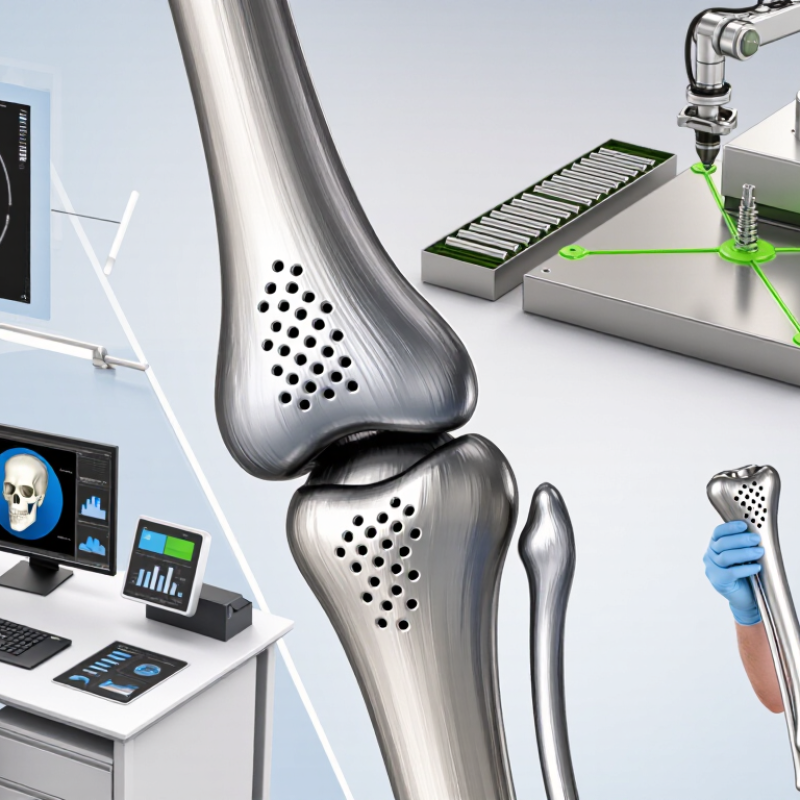
2026 Top Guide How Are Orthopedic Implants Customized?

What Are Orthopedic Implants and Why Are They Customized?

Orthopedic implants are medical devices placed inside the body to support, replace, or stabilize damaged bones and joints. They include joint replacements, bone plates, screws, rods, and spinal components. Materials may include titanium alloys, stainless steel, ceramics, or medical-grade polymers. Each material has different strength, weight, and tissue compatibility.

An implant is not simply a manufactured part. It must fit the patient’s anatomy and support real movement. Customization begins with X-rays, CT scans, or other clinical measurements. These images show bone shape, damage, alignment, and available space. Engineers can then create a three-dimensional plan for the implant. Surgeons review that plan using clinical experience and the patient’s treatment goals. A knee implant may need a specific angle. A spinal device may require a carefully measured height. Small differences matter.

Customization can improve fit, stability, and surgical planning, but it is not automatically better. Complex designs may cost more or require longer preparation. Medical images can also contain errors, and healing differs between patients. This is where careful communication becomes essential. The care team must compare the custom option with proven standard implants, possible risks, and expected daily activities. Patient preferences matter too. A technically accurate implant still needs realistic follow-up and rehabilitation. Good decisions depend on evidence, professional judgment, and honest discussion about uncertainty.

How Patient Data Guides Implant Design

How Are Orthopedic Implants Customized? How Patient Data Guides Implant Design

Customized orthopedic implants begin with patient-specific evidence, not a generic template. CT scans reveal bone density, joint angles, defects, and available fixation space. Surgeons also review age, activity level, previous operations, and movement patterns. The American Joint Replacement Registry’s 2024 Annual Report tracks more than three million hip and knee procedures, showing why large datasets matter. They reveal common failure patterns. They do not replace clinical judgment.

Software converts scan data into a three-dimensional anatomical model. Engineers can adjust implant thickness, screw direction, contact surfaces, and alignment targets. A narrow femur may require a different stem profile. A damaged acetabulum may need a stronger support structure. The FDA’s Technical Considerations for Additive Manufactured Medical Devices stresses design validation, material control, and process consistency. Personalization still needs testing.

Patient data can mislead. CT resolution, positioning errors, and incomplete medical histories may distort the design. A model can look precise. It may still be wrong. The OECD’s Health at a Glance 2023 reports substantial differences in joint-replacement rates across countries, reflecting varied disease patterns, healthcare access, and clinical decisions. Designers should therefore compare individual measurements with validated population data. Surgeons must question automated recommendations, especially when anatomy falls outside the dataset. Better customization is not maximum complexity. It is a traceable design linked to the patient’s real anatomy and functional needs.

Which Materials and Technologies Shape Custom Implants?

Custom orthopedic implants begin with a patient’s anatomy, not a standard size chart. High-resolution CT scans create a three-dimensional bone model. Engineers then map defects, joint alignment, and load-bearing areas. Surgeons review this model and adjust fixation points, implant thickness, and surgical access.

Material selection shapes both performance and recovery. Titanium alloys offer strength, light weight, and useful compatibility with bone growth. Cobalt-chromium alloys resist wear in demanding joint surfaces. PEEK can reduce imaging artifacts and support radiographic follow-up. Advanced ceramics provide smooth, durable bearing surfaces, but they require careful handling because brittleness remains a concern. Porous metal structures can encourage bone integration. Their pore size and depth need strict control.

Digital Design & Manufacturing Digital design tools connect imaging with computer-aided manufacturing. Additive manufacturing can create lattice interiors, patient-specific contours, and complex fixation features. Finite element analysis estimates stress before production. Each implant still needs dimensional inspection, material verification, sterilization control, and clinical review. Small errors matter.

Customization is not automatically better. A perfect digital model may reflect imperfect scan data. Bone quality can also change between planning and surgery. That limitation deserves honest discussion. Experienced teams compare software predictions with surgical judgment and validated clinical evidence. They document every design change, because traceability supports safer decisions. There is no universal material or technology. The best choice depends on anatomy, activity level, tissue condition, and the demands of long-term follow-up.

How Are Custom Orthopedic Implants Manufactured and Tested?

Custom orthopedic implants begin with a clinical need, not a standard catalogue size. A surgeon reviews CT or MRI data with engineers to define bone geometry, fixation points, and safe movement. The team converts these measurements into a digital model, checking thickness, angles, and contact surfaces. Patient anatomy can change the plan. That uncertainty matters.

Manufacturing may combine metal powder bed fusion with precision machining. Each layer is built from a controlled digital file, then excess material is removed and surfaces are refined. Technicians inspect critical holes, threads, and edges under magnification. They also record powder batches, machine settings, heat treatment, and cleaning steps. A custom shape is not automatically a safe shape. Design review must challenge assumptions, including areas that look acceptable on screen.

Testing covers dimensions, strength, fatigue, fixation, and surface condition. Engineers use calibrated instruments and validated methods to compare the implant with approved specifications. Mechanical tests may apply repeated loads that represent walking, lifting, or joint motion. The implant can also undergo cleaning, sterilization, and packaging checks before clinical use. Biological safety depends on material controls and documented evaluation. Results are reviewed by qualified specialists, with nonconforming findings investigated rather than hidden. In practice, the process is careful, but not perfect. A better question is whether every decision is traceable.

2026 Top Guide: How Are Orthopedic Implants Customized? – How Are Custom Orthopedic Implants Manufactured and Tested?

Customization and Manufacturing Dimension How It Is Customized Common Materials or Technologies Typical Verification or Acceptance Focus Relevant Standard Examples
Patient-Specific Design Input
  • CT or other clinically appropriate imaging is converted into a three-dimensional anatomical model.
  • The design may reflect bone geometry, defect size, fixation points, surgical access, and the intended range of motion.
Medical imaging data, segmentation software, CAD, and design-control records. Image quality, segmentation accuracy, design review, traceability, and documented surgeon approval. ISO 13485 quality-management principles; applicable medical-device design-control requirements.
Implant Geometry
  • Dimensions, curvature, porous regions, screw holes, fixation flanges, and contact surfaces can be adapted to the patient and surgical plan.
  • Design features must remain compatible with instruments and anatomical constraints.
CAD-based parametric modeling, computer-aided engineering, and finite-element analysis where appropriate. Dimensional inspection, fit assessment, mechanical analysis, and verification against approved design specifications. ISO 14630 for general requirements for non-active surgical implants; device-specific standards where applicable.
Material Selection The material is selected according to load, corrosion resistance, wear, fatigue performance, imaging requirements, tissue contact, and intended implantation duration.
  • Titanium and titanium alloys
  • Cobalt-chromium alloys
  • Stainless steel for suitable applications
  • Polyether ether ketone (PEEK) and other validated implant polymers
  • Alumina or zirconia ceramics in selected applications
Material identity, chemical composition, mechanical properties, biocompatibility assessment, and supplier traceability. ASTM F67 and ASTM F136 for titanium materials; ASTM F75 for cobalt-chromium-molybdenum alloy; ISO 10993 for biological evaluation.
Additive Manufacturing Complex lattice structures, patient-specific contours, and integrated fixation features may be produced layer by layer when the process is validated for the device. Metal powder-bed fusion, including laser or electron-beam processes, followed by heat treatment and finishing as required. Powder control, build-process monitoring, density, porosity, surface condition, dimensional accuracy, mechanical properties, and batch traceability. ASTM F ASTM F2924 for titanium alloy additive manufacturing; ASTM F3001 for Ti-6Al-4V ELI produced by laser powder-bed fusion.
Machining and Surface Finishing Critical interfaces, holes, threads, tapers, bearing surfaces, and mating features are machined or finished to the approved design. CNC machining, polishing, abrasive finishing, blasting, chemical treatment, or other validated processes. Surface roughness, edge condition, burr removal, thread and hole dimensions, cleanliness, and preservation of porous structures. Device-specific drawings and validated process specifications; ASTM F86 for preparation and handling of metallic surgical implants.
Porous or Coated Surfaces Porous regions or coatings may be positioned to support biological fixation or control the interface with bone, provided the clinical indication supports their use. Integrated metallic lattice structures, porous coatings, hydroxyapatite, or other validated surface treatments. Coating adhesion, phase or composition where relevant, pore characteristics, particulate control, fatigue behavior, and cleanliness. ASTM F1580 for titanium and titanium-6 aluminum-4 vanadium alloy powders for coatings; ISO 13779 series for hydroxyapatite-related requirements.
Mechanical Verification The test plan is selected according to implant type, load path, fixation method, failure mode, and intended clinical use. Static compression, tensile, bending, torsion, fatigue, wear, pull-out, or subsidence testing as applicable. Strength, stiffness, fatigue life, deformation, wear debris, fixation performance, and comparison with defined acceptance criteria. ISO 7206 for hip-joint prostheses; ASTM F1717 for spinal implant constructs; ASTM F543 for metallic bone screws, where applicable.
Biological Evaluation Biological risks are assessed based on the final materials, processing residues, surface treatments, contact type, and duration of contact. Biocompatibility assessment of the finished or representative device, including chemical characterization when needed. Cytotoxicity, sensitization, irritation, systemic toxicity, genotoxicity, implantation effects, and other endpoints justified by risk assessment. ISO 10993-1 and other applicable parts of the ISO 10993 series.
Cleaning and Particulate Control Cleaning processes are adapted to remove machining residues, powder, oils, chemicals, and other process contaminants without damaging the implant. Aqueous cleaning, ultrasonic cleaning, validated chemical cleaning, rinsing, drying, and controlled packaging. Residual chemicals, visible contamination, non-viable particulate matter, microbial control, and process reproducibility. ASTM F86 for preparation and handling of metallic surgical implants; validated internal cleanliness specifications.
Sterilization and Packaging The sterilization method and packaging system are selected according to material compatibility, device geometry, shelf life, and the intended clinical use. Ethylene oxide, radiation, moist heat, or another validated method suitable for the specific device. Sterility assurance, residual sterilant where relevant, package integrity, aging, transport simulation, and aseptic presentation. ISO 11135 for ethylene oxide; ISO 11137 for radiation; ISO 17665 for moist heat; ISO 11607 for sterile-barrier packaging.
Final Inspection and Release Each custom implant is checked against its approved patient-specific design and manufacturing history before release. Coordinate-measuring equipment, optical inspection, computed tomography inspection where justified, and electronic device records. Dimensions, surface condition, markings, lot or serial traceability, inspection status, nonconformance review, and release authorization. ISO 13485 quality records and applicable regulatory documentation requirements.
Clinical and Surgical Planning The implant design is reviewed together with the surgical approach, fixation strategy, instruments, anatomical risks, and contingency plan. Patient-specific surgical guides, trial components, planning software, and validated imaging-based workflows. Usability, compatibility with instruments, surgical fit, labeling, instructions for use, and risk controls for foreseeable misuse. ISO 14971 for medical-device risk management; applicable usability-engineering requirements.

What Happens During Implant Placement and Long-Term Follow-Up?

During implant placement, the surgical team follows a plan shaped by your anatomy, movement needs, and imaging results. Customized measurements may guide implant size, alignment, and positioning. The surgeon also checks nearby bone and soft tissue before securing the implant.

Placement is only one part of treatment. After surgery, staff monitor pain, swelling, circulation, wound healing, and early movement. Physical therapy often begins with simple exercises, such as ankle pumps or assisted walking. Recovery is rarely perfectly predictable. A patient may progress quickly, then face stiffness or fatigue without warning. That is why follow-up appointments matter.

Tips: Keep every scheduled visit. Report increasing warmth, drainage, fever, sudden pain, or unusual swelling promptly. Use walking aids exactly as instructed, even when you feel stronger. Do not change exercise intensity without professional guidance. Follow-up may include physical examinations and imaging to check alignment, bone response, and implant stability. Long-term reviews help identify loosening, wear, or changes in joint function before they become severe. Patients should also share new medications, falls, and changes in activity. Small details can influence clinical decisions. Some advice may need adjustment over time, and that is normal. An individualized plan should be explained clearly, with benefits, limitations, and possible complications discussed before treatment.

FAQS

What are orthopedic implants?

Orthopedic implants are medical devices placed inside the body. They support, replace, or stabilize damaged bones and joints. Examples include joint replacements, plates, screws, rods, and spinal components.

Why are some orthopedic implants customized?

Customized implants match a patient’s bone shape, damage, alignment, and available space. Even a small angle or height difference can affect movement and stability. Standard sizes may not fit every anatomy.

How is a custom implant designed?

X-rays, CT scans, and clinical measurements provide planning information. Engineers create a three-dimensional bone model from these images. Surgeons then review fixation points, implant thickness, and surgical access.

Which materials may be used in orthopedic implants?

Common materials include titanium alloys, stainless steel, cobalt-chromium alloys, ceramics, and medical-grade polymers. Titanium is strong and light. Ceramics can provide smooth surfaces but may be brittle.

How does technology support custom implant development?

Digital design connects medical imaging with computer-controlled manufacturing. Additive manufacturing can create porous interiors and complex fixation features. Stress analysis estimates pressure before production.

Can customized implants improve treatment?

Customization may improve fit, stability, and surgical planning. It can also help address unusual bone defects. However, it is not automatically better.

What limitations should patients understand?

Medical images can contain errors. Bone quality may change between planning and surgery. Digital predictions are useful, but they are not always correct.

What checks are needed before a custom implant is used?

The implant requires dimensional inspection, material verification, sterilization control, and clinical review. Design changes should be documented carefully. Small errors matter.

How should patients and care teams choose between options?

They should compare custom and proven standard implants. The discussion should include risks, costs, recovery, daily activities, and follow-up needs. Honest uncertainty matters.

Conclusion

Orthopedic implants are medical devices designed to support, replace, or restore damaged bones and joints. Because every patient has different anatomy, bone quality, activity levels, and medical needs, customization can improve fit, stability, and functional recovery. What is the process of customizing orthopedic implants for specific needs? It begins with patient data, including medical imaging, physical assessments, and surgical goals. This information helps specialists create a detailed digital model and determine the implant’s shape, size, alignment, and fixation method.

Advanced materials such as medical-grade metals, ceramics, and polymers may be selected according to strength, durability, weight, and tissue compatibility requirements. Digital design, precision manufacturing, and additive production technologies can then create the implant, which undergoes dimensional, mechanical, cleanliness, and biocompatibility testing. During placement, surgeons use the customized design to guide positioning and secure the implant. Long-term follow-up includes imaging, functional evaluations, rehabilitation guidance, and monitoring for comfort, stability, and implant performance.

Madeline

Madeline

Madeline is a dedicated marketing professional with a wealth of expertise in our company's core offerings. With a keen understanding of the industry, she brings a unique perspective to her role, consistently delivering high-quality content that highlights the superior aspects of our products. As......